Your chess has a shape: the skills a single rating hides
Two players are both rated 1400. One calculates well but drifts in quiet positions, choosing moves with no plan behind them. The other judges positions accurately but regularly leaves a piece where it can be taken. Same rating, completely different problems, and the same training won't fix both.
A rating tells you how strong you are. It doesn't tell you why, or what to work on next.
Seven things that happen in every move
Over the past five weeks we've looked at where games are lost: in quiet positions with no tactic to find, in endgames judged wrongly, in moves found quickly but never checked, in positions with no plan, and in moves refuted by a single capture, check or threat. Each of those is a different skill.
Choosing a move draws on seven of them, roughly in this order:
- Perception. Seeing what's on the board: what's attacked, what's loose, what's pinned.
- Opponent intent. Working out what your opponent wants to do next.
- Candidate moves. Finding the few moves worth considering.
- Calculation. Following a line forward and holding the position in your head.
- Evaluation. Judging who is better at the end of it.
- Planning. Knowing what you're trying to do when nothing is forced.
- Verification. Checking the move you've chosen before you play it.
A player can be strong at some of these and weak at others. Most are.
Two players, one rating
Here are the two players from the start, drawn as profiles. They are invented to show the idea, and both average out to the same rating.
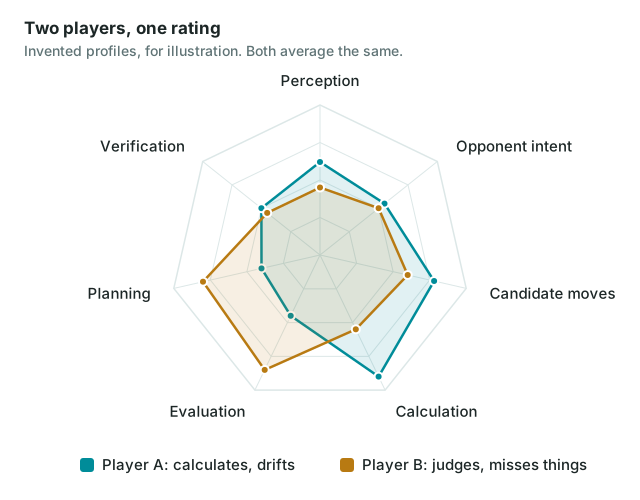
Player A needs plans and judgement; more tactics would mostly train what's already strong. Player B needs to see and check: threats, safety checks, and positions where something is hanging. A single number can't tell them apart. The shape can.
How OptiChess builds your profile
Every kind of question in OptiChess leans on one of these skills more than the others. A tactic is mostly calculation, or finding the candidate move; What's the threat? is opponent intent; Who's better? is mostly evaluation.
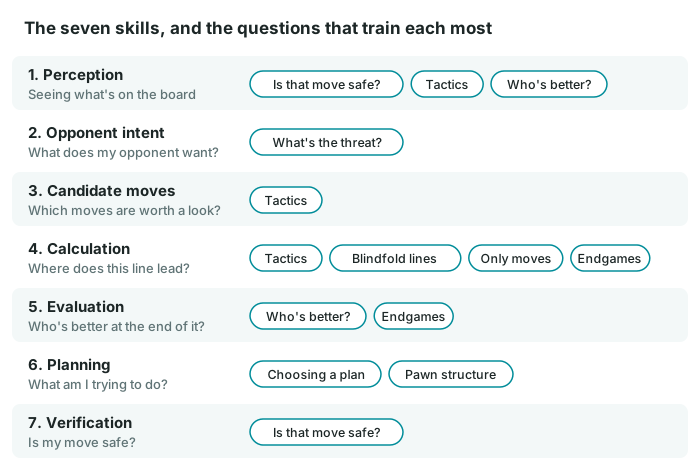
Each question you answer updates your ratings in the skills it draws on, so over a few weeks of training your profile fills in. Your Progress page draws it as a web with one axis per skill, alongside a second web by kind of question.
Two things follow from that:
- The training aims at the dents. The skills you're behind in come up more often, because that's where the points are.
- Getting better means getting rounder, not just bigger. Polishing your strongest skill feels good, but the points you're losing are mostly in your weakest.
A profile is only as good as the answers behind it. After a handful of questions it's a rough sketch; after a few hundred, spread across every kind of question, it starts to say something you can act on.
Finding your shape
You don't need an account to start: after a few questions your first ratings appear. What your profile shows after a few weeks may surprise you. Most players already know their strongest skill. Fewer know their weakest one.
Try it. Real positions, set at your level, every answer checked against the board. No account needed to start.
Start training