Why puzzles don't transfer to your games
Puzzles are the most popular way to train chess, and they work: solve enough of them and your puzzle rating goes up. But plenty of players find that their games don't follow. The puzzle rating climbs and the club rating sits still.
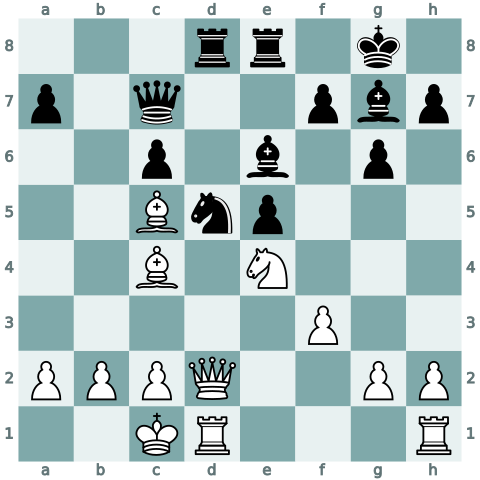
We wanted to know why, so we looked at what real games actually ask of you. (We'll come back to the position above.)
What we checked
Stockfish checked 22,109 positions from real online rapid games: every position after the opening in 490 Lichess games, spread over five rating bands from under 1,200 to 2,400, with both players inside the band. For each one we asked two questions. Was there a single move that won, a tactic of the kind a puzzle is built on? And where did the players actually lose points?
We ran the same check on 300 games between stronger players too (median rating about 2,350), and the answers came out almost the same. The details are at the end of this post.
A winning tactic comes up once in 57 moves
In a puzzle set, every position has a winning move. That is what makes it a puzzle. In the games we checked, about one position in 57 did.
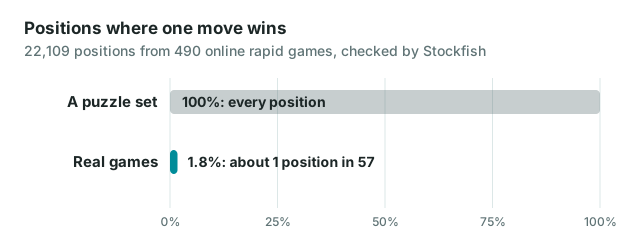
Fewer than half the games had even one such moment. And in more than a fifth of all positions, the best two moves were worth almost exactly the same: nothing to find, just a sound move to choose.
That is the first thing a puzzle can't train. A puzzle tells you there is something to find before you start looking. A game never tells you, and most of the time there isn't.
Most points are lost with no tactic on the board
When a winning tactic did come up, players found it a little under two times in three: 57% of the time at 1,200–1,500, rising to 72% at 2,100–2,400. That's not bad, and it shows puzzle training is doing some of its job.
But that isn't where most of the points went. We counted every move that threw away two pawns or more from a position that was still in the balance, plus every winning tactic that wasn't played. That came to 1,020 mistakes. Only 142 of them were missed tactics. The other 878, 86% of the total, came in positions where there was no tactic to find at all. It hardly changes with rating: between 83% and 89% in every band, and 87% among the stronger players.
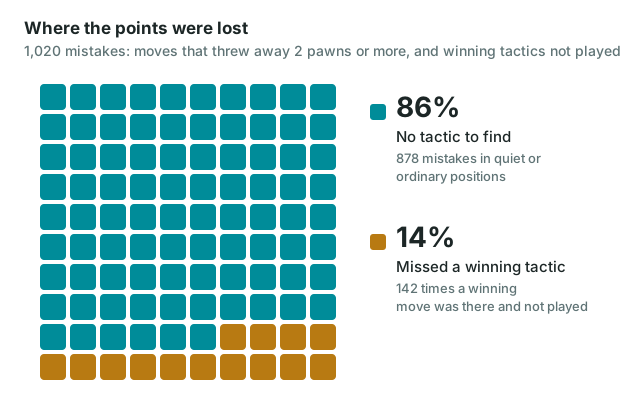
These are the moves that lose games: a piece left where it can be hit, an attack that walks into a counter-blow, a quiet move that gives up a square for good. Many of them turn the game into a puzzle, but for the other player. In 238 of the 878, the mistake handed the opponent a winning tactic, and the opponent found it 155 times.
The position at the top of this post is one of them. It comes from a game between two players rated over 2,300, which shows it doesn't go away with strength. It is level, and Stockfish rates three different moves as equally good. In the game White played 16.Nd6, attacking the rook on e8 and looking active.
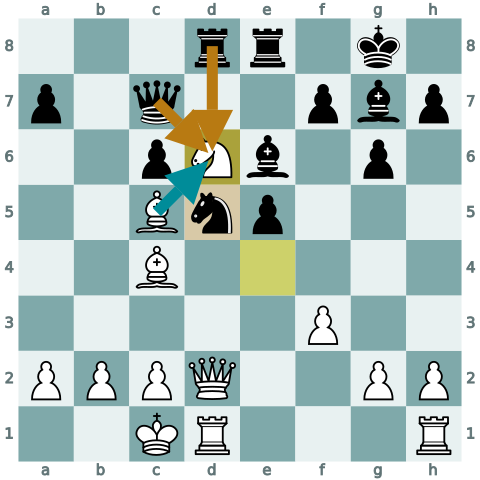
The knight on d6 is attacked twice, by the rook on d8 and the queen on c7, and defended once, by the bishop on c5. White's queen would defend it too, but Black's knight on d5 is in the way. So 16...Rxd6 17.Bxd6 Qxd6, and Black has two pieces for a rook: about two pawns up, by Stockfish's count. The same jump is fine a move later: in Stockfish's main line, 16.Bb3 Nf4 17.Nd6 holds the balance, because with Black's knight gone from d5 the queen defends d6.
Nothing in the position announced it. There was no tactic for White to find. The only question was "what does this move allow?", and that is a question puzzles never ask, because in a puzzle the answer is always "nothing, it wins".
What to train instead
None of this means puzzles are a waste of time. More than a third of winning tactics went unplayed, and spotting them is worth training. But if tactics are all you train, you are working on 14% of the problem.
The rest is judgement in ordinary positions, and it can be trained too:
- Check the move before you play it. Many of those mistakes are moves a player would have rejected if they had asked "what does this allow?" first.
- See your opponent's threat. Before choosing a move, work out what the other side wants to do.
- Judge the position. Is it better, equal or worse? That decides whether to attack, defend or simplify.
- Choose a plan. When nothing is forced, the pawn structure tells you where to play.
These are the questions OptiChess asks, from positions in real games where they actually came up. You can see how it trains, or try a few positions now. You'll notice that most of them don't tell you there's something to find.
How we checked
- Games: 490 rapid games from our library of real Lichess games, in five rating bands (under 1,200, 1,200–1,500, 1,500–1,800, 1,800–2,100 and 2,100–2,400). Both players' ratings are inside the band, and each game comes from a different player in that band. There are 100 games in each band except the lowest, which has 90: every player in our library with a game there. Games against bots and games from set-up positions were left out.
- Positions: every position from move 11 on, leaving out positions with a single legal move: 22,109 in all.
- How precise: we resampled the games thousands of times to see how much the figures move. The 86% is accurate to about two points either way (84% to 88%), and "once in 57 positions" to somewhere between once in 51 and once in 64. Figures for a single rating band rest on fewer mistakes and are rougher, so we don't read much into small differences between bands.
- The stronger players: a separate sample of 300 games, one each from 300 players chosen at random from the whole library, turned out to be mostly strong players (median rating about 2,350). Its results: a winning tactic once in 65 positions, found three times in four, and 87% of mistakes with no tactic to find.
- Engine: Stockfish at depth 18, giving its two best moves for each position.
- A winning tactic: the best move puts the side to move two pawns or more ahead (or mates), the second-best move does not get within a pawn of that, and the side to move wasn't already winning before the opponent's last move. The share barely changes at 1.5 or 3 pawns instead of 2: between 1.7% and 1.8% of positions either way.
- A mistake: a move that gives away two pawns or more from a position no more than three pawns either way, plus every winning tactic not played, whatever it cost.
Try it. Real positions, set at your level, every answer checked against the board. No account needed to start.
Start training