How OptiChess trains: the decisions that decide games
Most chess training is a list of tactics puzzles. Puzzles are good, and OptiChess has thousands of them, but they train one thing: finding a winning blow when you already know there is one. Games are rarely lost that way. They are lost when you don't notice your opponent's threat, when the move you were sure of drops a piece, when you misjudge a position, choose the wrong plan, or reach an endgame you can't convert.
OptiChess trains those decisions. This is how it works.
Nine kinds of question, from real games
Almost every position comes from a real game (the exceptions are a few textbook endgames), most of them rapid games between club players, and the hardest from games of players rated 2200 and more on Lichess. Real games give you the positions you actually reach, not the ones that make neat puzzles.
From those games, OptiChess asks nine different kinds of question:
- Tactics. Find the move that wins. The puzzle stops where the win is on the board, not where an engine says you're better.
- Is that move safe? You're thinking of playing a move: can your opponent gain anything? Sometimes yes, sometimes no, and the tempting captures that don't work are explained.
- Threats. Before you move, what is your opponent threatening? The habit most club players lack, and almost nowhere trains it.
- Assessment. Who stands better? Judging a position without calculating it out.
- Weaknesses. Find the isolated pawn, the backward pawn, the hole your knight can use.
- Plans. In a known pawn structure, which plans make sense? Taken from published sources on that structure, not invented.
- Endgames. Won, drawn or lost, and then play the move that keeps it that way. Checked against endgame tablebases.
- Only moves. One move holds the position; everything else loses. Finding it under pressure is what saves points.
- Blindfold lines. The board shows the position a few moves ago and the moves are written out. Find the move at the end without seeing it played. This is calculation: holding a position in your head.
Every answer is checked against the board
An exercise with a wrong answer teaches the wrong lesson, so every answer key is checked by engine or tablebase, not by opinion. Where another move is just as good, it counts as right. Where a threat could take either of two pieces, both are accepted. Where a capture looks tempting but fails, the explanation shows the line that wins the material back.
After each item you can step through the line on the board, and open the position on Lichess's analysis board to go as deep as you like.
Set at your level, and moving with you
OptiChess keeps a rating for you in each skill, on a scale aimed at FIDE ratings, and serves each kind of question near your level in it. Do badly and the questions ease off; do well and they get harder. Speed counts too: solving cleanly and quickly moves you further than solving slowly.
Your skills are drawn as a web, one axis each. A single rating can't show that you calculate well but misjudge positions, or see your own chances and miss your opponent's; the shape does, and training aims at the dents.
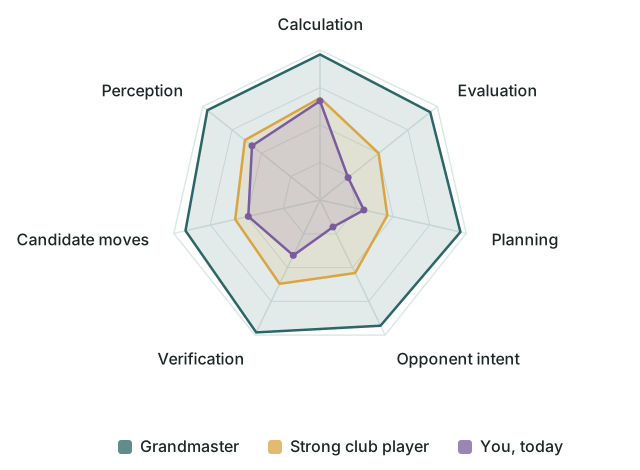
The mix changes with your rating. A beginner sees mostly tactics, safety checks and threats. A strong club player sees more plans, only moves and longer blindfold lines. The skills you are behind in come up more often, because that's where the points are.
A few minutes a day
Training works best little and often. Ten or twenty questions a day takes a few minutes, and the record of how you did is on your Progress page, by skill and by type of question, so you can see what is moving and what isn't.
You don't need an account to try it: start training and your first questions come straight away.
Try it. Real positions, set at your level, every answer checked against the board. No account needed to start.
Start training