Check your move before you play it
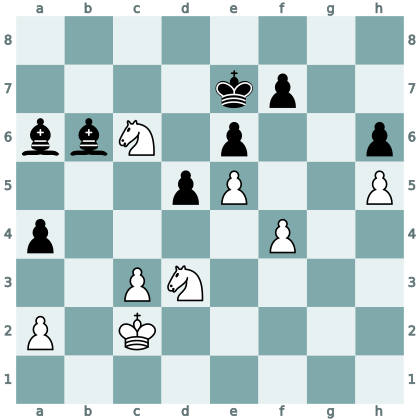
This is an endgame from one of the games we analysed for the first post in this series, between two players rated over 2,300 on Lichess. It's level: Stockfish rates 33...Ke8 and 33...Kf8 as exactly equal. Black played 33...Kd7, bringing the king towards the centre, which is usually right in an endgame.
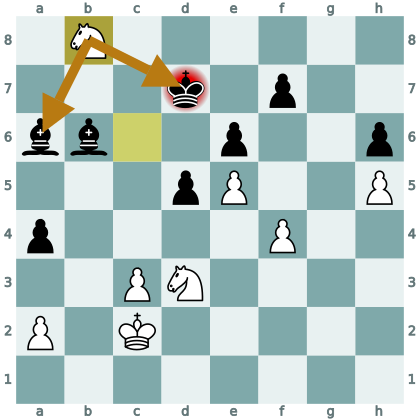
34.Nb8+ forks the king and the bishop on a6, and Black is a piece down. Nothing about 33...Kd7 was a bad idea. It just wasn't checked.
The mistakes that lose games
In the 2,000 games behind that post, rated from under 1,200 to 2,400, 3,666 moves threw away two pawns or more from a position that was still in the balance, with no tactic for the player to find. We looked at how each one was punished: Stockfish's best reply for the opponent.
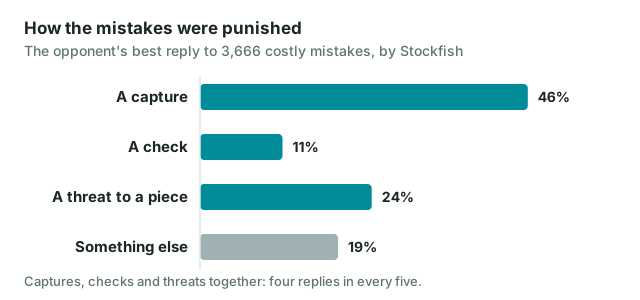
In four cases out of five, the punishment was a capture, a check, or a move that attacked a piece that was undefended or worth more than its attacker. Nearly half were simply a capture. And it hardly changes with rating: between 79% and 84% in every band, and three in four among the stronger players we also checked. None of these are deep. They are the first things an opponent looks at, and they are exactly what a player should look at before letting go of a piece.
Hope chess
The chess teacher Dan Heisman has a name for playing without that check: hope chess, making moves without looking at the opponent's possible forcing replies (checks, captures and threats) and hoping there will be a safe answer when they come. He describes good players as ones who learn to analyse their candidate moves for safety automatically.
Our numbers put a size on it. Most of the costly mistakes in these games weren't strategic misjudgements or deep combinations missed. They were moves refuted by a single capture, check or threat.
A check you can do every move
Before you play a move, picture the position after it, and look at it from your opponent's side:
- Checks. What checks does my opponent have now? Include checks that also attack something, like 34.Nb8+.
- Captures. What can be taken? Is the piece I just moved safe where it stands? Is anything I left behind now loose?
- Threats. What does my opponent attack after this move, and what could they attack with one move?
If any answer is "I lose something", go back and choose again. Most of the time the answer is "nothing", and the check takes a few seconds. As we saw in Speed of thought, strong players find their candidate move quickly, which is what leaves them time for this.
Making it a habit
A checklist only helps if you use it when you're not expecting trouble, and that's when it's hardest. The way to build the habit is to practise the question itself on positions where you don't know whether the answer is yes or no.
That's what the Is that move safe? questions in OptiChess's blunder trainer do. You're shown a move you might play in a real position and asked whether your opponent can gain anything from it. Sometimes they can, sometimes they can't, and when a tempting move fails, the explanation shows the line. What's the threat? questions train the other half: seeing what your opponent wants before you choose your move.
How we checked
- Games and mistakes: the same 2,000 games as in Why puzzles don't transfer to your games, in five rating bands from under 1,200 to 2,400, with the same definition of a costly mistake: a move that gives away two pawns or more from a position no more than three pawns either way, in a position with no winning tactic for the player.
- The punishing reply: Stockfish's best move for the opponent in the position after the mistake (depth 18).
- A threat to a piece: after the reply, one of the player's pieces or pawns (not the king) is attacked and is either undefended or worth more than the cheapest piece attacking it. This is a simple count that ignores pins and deeper ideas, so treat it as a rough guide.
- The example position was checked separately with Stockfish 16 at depth 24: 33...Ke8 and 33...Kf8 are level, and after 33...Kd7 34.Nb8+ White is about four pawns ahead.
Try it. Real positions, set at your level, every answer checked against the board. No account needed to start.
Start training