Speed of thought: why stronger players see it sooner
Show the same position to a club player and a grandmaster, and both may find the right move. The difference is how long it takes. The grandmaster often sees it almost at once. The club player gets there, but only after working it out.
That gap matters more than it looks. In a game, the clock is always running, and the time you save on one move is time you can spend on the move that decides the game. So where does the speed come from, and can you train it?
Strong players see more at a glance
In a famous study from 1973, Chase and Simon showed players a chess position for a few seconds and asked them to set it up again from memory. The strongest player recalled far more than the weaker ones, but only when the position came from a real game. When the pieces were placed at random, the advantage disappeared.
So strong players don't have better memories. They have a larger store of familiar patterns: a castled king with a pawn on h6, a knight that has reached an outpost, a rook on an open file. They see a position as a few meaningful groups rather than twenty-odd separate pieces, and with those groups come the ideas that usually go with them.
Most of a strong player's strength survives with very little time
If strength were mostly calculation, taking away thinking time should take away most of the strength. It doesn't.
In 1996, Gobet and Simon looked at one of the world's top grandmasters playing several grandmasters at once, with far less time per move than in a tournament. His playing strength was only slightly lower. Their conclusion was that recognition, built on knowledge, does more of the work than looking ahead.
Bruce Burns took the same question to blitz in 2004. Five-minute games leave less than 5% of the usual thinking time, yet blitz results accounted for up to 81% of the differences in players' ratings.
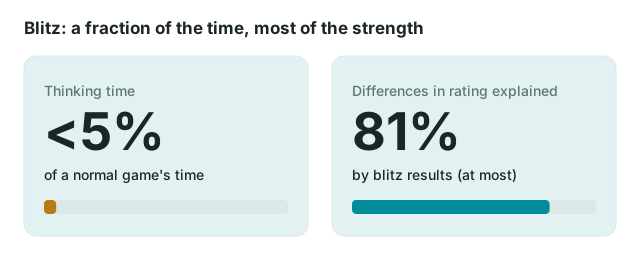
Burns also found the link was weaker among lower-rated players. Their quick judgement is less developed, so when the clock takes away the time to calculate, more of their strength goes with it.
But fast isn't the same as right
None of this means you should play your first instinct. When Moxley and colleagues asked players to think aloud while choosing a move, the first move they considered was often worse than the one they settled on after thinking, and that was true even for masters.
So strong players aren't fast instead of careful. They're fast to find a good candidate, which leaves them time to check it. Weaker players spend their time finding a candidate, and then have no time, or no habit, of asking what it allows.
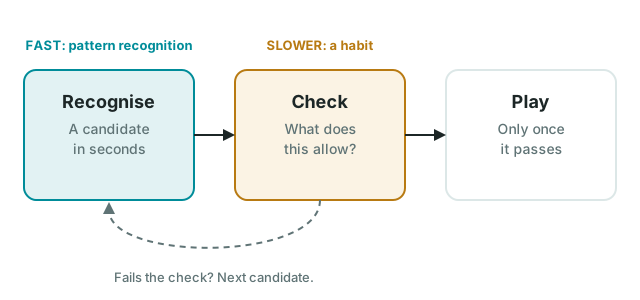
That's the pattern from our look at 490 online games: most of the points were lost on moves that nobody checked, not on tactics nobody saw.
Training both halves
The usual explanation for the patterns strong players carry is experience: they have seen thousands of real positions and remember what happened in them. You can't shortcut that, but you can make it more efficient:
- See many real positions, quickly, with the answer straight after. Recognition grows from positions that actually come up in games, each followed by the right idea while it's fresh.
- Let speed count. If a position takes you a minute today and ten seconds next month, that's progress your rating should see, not just whether you got it right.
- Train the check as a habit. A recognised move still needs one question before you play it: what does this allow?
- Hold the board in your head. Calculation depends on picturing the position a few moves on. Visualisation can be practised on its own.
This is what OptiChess is built around. Every position comes from a real game, the answer and its explanation come straight after you move, and solving cleanly and quickly moves your rating further than solving slowly. Alongside tactics there are positions that ask whether a move is safe, what your opponent is threatening, and blindfold lines where you find the move at the end of a sequence you can't see played.
Sources
- Chase, W. G. & Simon, H. A. (1973). Perception in chess. Cognitive Psychology, 4, 55–81.
- Gobet, F. & Simon, H. A. (1996). The roles of recognition processes and look-ahead search in time-constrained expert problem solving: evidence from grand-master-level chess. Psychological Science, 7, 52–55.
- Burns, B. D. (2004). The effects of speed on skilled chess performance. Psychological Science, 15, 442–447.
- Moxley, J. H., Ericsson, K. A., Charness, N. & Krampe, R. T. (2012). The role of intuition and deliberative thinking in experts' superior tactical decision-making. Cognition, 124, 72–78.
Try it. Real positions, set at your level, every answer checked against the board. No account needed to start.
Start training