Choosing a plan from the pawn structure
In our look at 2,000 online games, more than a fifth of all positions were quiet: the best two moves were worth almost exactly the same, and there was nothing to calculate. In those positions, the question isn't "what wins?" but "what am I trying to do?"
That's what a plan is. And the best guide to a plan is the one part of the position that hardly changes: the pawns.
Why the pawns
Pieces move around every few moves. Pawns can't move backwards, so once the structure is set it usually stays for much of the game. It decides which squares are strong, which files will open, and where each side's pawn breaks are. Strong players learn the common structures and the plans that go with them, so in a new position they recognise the structure first and the plan follows.
Here are three structures that come up again and again at club level, with the plans for each side. Each plan below is taken from published sources, linked at the end, not from our own judgement. In the diagrams, the pieces are left out so the structure shows: teal arrows are White's plans, gold arrows Black's.
1. The isolated queen's pawn
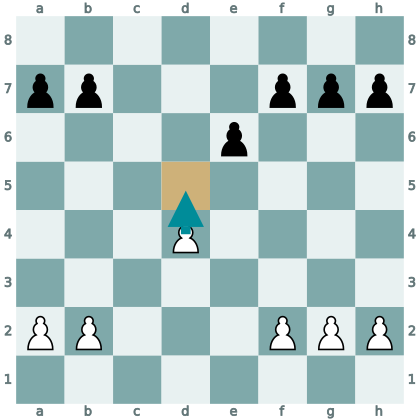
White's d-pawn has no neighbours on the c- or e-file, so no pawn can ever defend it. It's a weakness and a strength at once, and which one wins depends on what happens to the pieces.
The side with the isolated pawn wants activity while the pieces are on:
- Break with d4–d5, opening the position while its pieces are better placed.
- Attack the king with pieces.
- Keep pieces on and avoid trades. The pawn gets weaker as the board empties.
The other side plays against the pawn:
- Blockade it with a piece on d5, so it can never advance.
- Trade pieces and head for the endgame, where the isolated pawn is a lasting weakness.
- Pile up on the pawn and win it.
2. The Carlsbad
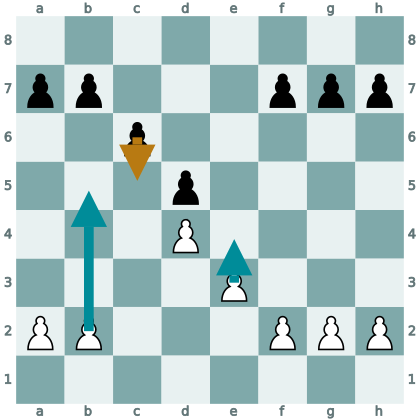
This comes from the Exchange Variation of the Queen's Gambit Declined, and with colours reversed from the Exchange Caro-Kann.
White's best-known plan here is the minority attack:
- Push the b-pawn up the board with b4–b5, two pawns against Black's three, to swap it off for Black's c-pawn and leave Black with a weak pawn, usually on c6.
- Or break in the centre with e3–e4, usually prepared with f2–f3.
Black's answers:
- Break with c6–c5, changing the structure (often into an isolated queen's pawn, above).
- Slow White's queenside advance with moves such as …a5 or …b5.
3. The French chain
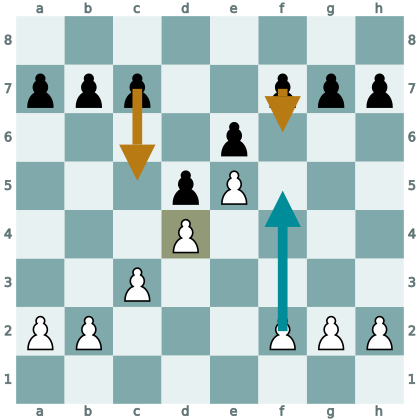
Two pawn chains lock against each other. White has more space on the kingside, Black has the c-file and the base of White's chain to aim at.
White plays where its chain points, on the kingside:
- Gain space with f2–f4–f5.
- Attack the king with pieces.
Black attacks the chain:
- Strike at its base with c7–c5. In Sam Collins's words, d4 is "his main target".
- Hit the head of the chain with f7–f6.
- Use the c-file once it opens, and try to trade off the light-squared bishop, which is shut in behind Black's own pawns on light squares.
Reading a structure you don't know
Not every position is one of these. But the same questions carry over:
- Which pawns can be attacked, and which squares can never be covered by a pawn again? Those are targets and outposts.
- Where are the pawn breaks? A plan usually leads to one: d4–d5, b4–b5, c7–c5, f7–f6.
- Which way do the pawn chains point? In the French, White plays on the kingside and Black on the queenside, each where its chain gives it room.
- Who benefits from trades? The side with a weakness, like the isolated pawn, wants pieces on. The side playing against it wants them off.
Training it
OptiChess has two kinds of question built on this. Choosing a plan shows you a position from a real game in one of these structures and asks which plans make sense for the side to move, then asks you to play the move that starts one. Pawn structure asks you to find the outposts and the weak pawns that plans are aimed at. The plans in the answers come from the published sources below, and every claim in them, such as an outpost or a target pawn, is checked against the position on the board.
Sources
- Andrew Soltis, Pawn Structure Chess, and Mauricio Flores Rios, Chess Structures: A Grandmaster Guide (Quality Chess, 2015): the standard books on this topic.
- Wikipedia: Isolated pawn and Pawn structure.
- GM Bryan Smith on chess.com: Attack and defence in the IQP.
- chess.com: Carlsbad pawn structure and Wikipedia: Queen's Gambit Declined.
- TheChessWorld: defensive strategies in the Carlsbad.
- Sam Collins on ChessBase: the French Advance structure, Exeter Chess Club: French key ideas, and Anish Giri on Chessable: the French.
Try it. Real positions, set at your level, every answer checked against the board. No account needed to start.
Start training