Won, drawn or lost? Three endgames to judge before you calculate
Last week we looked at where points are actually lost: mostly in positions with no tactic to find, where the job is to judge the position rather than calculate a combination.
Endgames are where that judgement pays most directly. With few pieces left, one question decides how you play: is this won, drawn or lost? If it's won, you look for the move that keeps it won. If it's drawn, you look for the way to hold. If you don't know, you calculate everything and hope.
Here are three positions. Each is decided by one idea you can learn once and use for the rest of your chess life. Before you calculate anything, decide what the result should be. The answers are further down.
1. The race
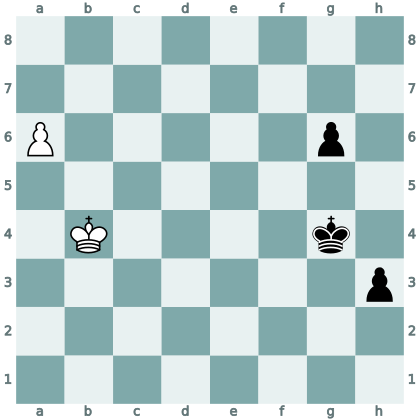
Both sides have a pawn about to run. Who gets there first, and does it matter?
2. A piece and a pawn up
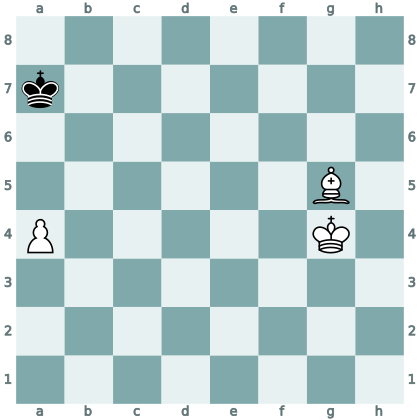
White is a whole bishop and a pawn ahead. Surely that's enough?
3. King and pawn
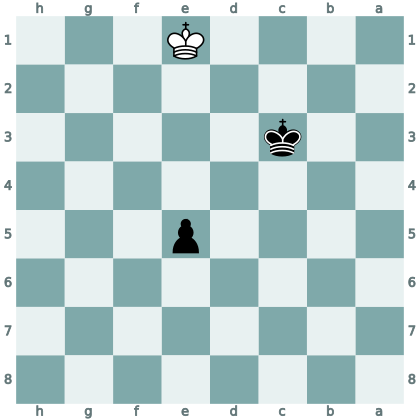
Black is a pawn up with the king well forward. Can Black win, and how?
The answers
1. Won, but only with 1.a7
Count the squares. Black's king is far outside the square of White's a-pawn, so it can never catch it. White's king is just as far from Black's h-pawn. So both pawns run, and this is a race.
White moves first: 1.a7 h2 2.a8=Q. Black's pawn is one step from queening, but the new queen on a8 looks straight down the long diagonal at h1.
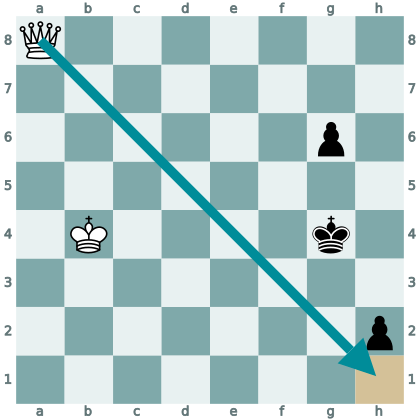
What makes this position worth knowing is the other moves. Stockfish checked every legal move White has, and every one apart from 1.a7 loses. Any king move gives Black the tempo, Black queens first, and White's pawn is too slow. One move wins and eight moves lose. Judging "this is a race, and I'm a tempo ahead" is the whole of it.
2. Drawn, whatever either side does
This is the wrong bishop. White's pawn is a rook's pawn: it queens on a8, a light square. White's bishop runs on dark squares, so it can never attack a8 or drive Black's king out of the corner. Black's king goes to a8 and stays there, and the best White can do is stalemate.
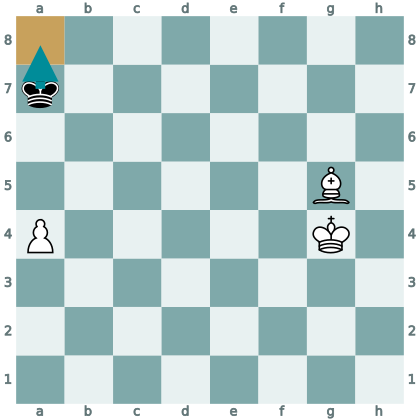
Stockfish confirms it: with Black to move, every move holds. With White to move, every one of White's 17 moves still draws. A whole piece ahead and nothing to show for it. This is the kind of position to recognise before you trade into it, not after.
3. Won, but only with 1...Kd3
The idea is key squares. For a pawn on e5 (heading down the board for Black), the key squares are d3, e3 and f3. If the attacking king reaches any of them, the pawn queens whatever the defender does.
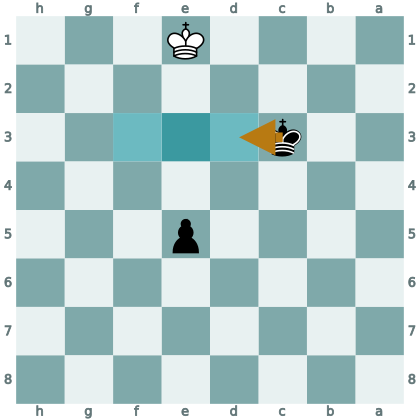
1...Kd3! is the only winning move. Black's king takes a key square before the pawn moves, and from there it walks the pawn home.
The natural move, 1...e4, throws the win away. It looks like progress, but it gives White the time for 2.Ke2!, the only drawing reply: White's king now guards d3, e3 and f3, and Black's king never reaches a key square. Stockfish's verdict: 1...Kd3 wins, and all seven alternatives draw.
Judge first, then calculate
In all three positions, the move came from the verdict. Once you know it's a race you're winning, 1.a7 is obvious. Once you know it's the wrong bishop, you stop trying and save your energy, or you avoid the trade that leads to it. Once you know about key squares, 1...Kd3 is the only move worth looking at.
That's the order OptiChess trains endgames in. Endgame questions ask "won, drawn or lost?", and then ask you to play the move that keeps the result. The positions come from textbook set-ups and from real games. Every answer is checked against endgame tablebases, which know the exact result of every position with few pieces left, or by engine where there are too many pieces for them.
All three ideas here, the square of the pawn, the wrong bishop and key squares, are in any good endgame book. Jeremy Silman's Complete Endgame Course is a friendly place to start.
Try it. Real positions, set at your level, every answer checked against the board. No account needed to start.
Start training