What your mistakes look like at every level
When you're rated 1300, it's natural to assume a 2200 player loses games in some deeper, more sophisticated way than you do. A subtle misjudgement, a long combination missed.
We checked. Using the 2,000 online games behind Why puzzles don't transfer to your games, 400 in each of five rating bands from under 1,200 to 2,400, we sorted every costly mistake by what kind of mistake it was. The answer surprised us: the kinds of mistake hardly change. What changes is how often they happen.
Stronger players make the same mistakes, less often
A costly mistake here is a move that gave away two pawns or more while the game was still in the balance, or a winning tactic that wasn't played. Under 1,200, players made one about every five moves. Between 2,100 and 2,400, about every sixteen.
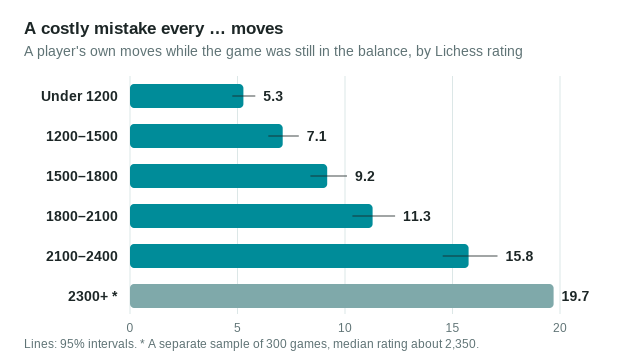
It rises step by step: each band's interval is clear of the next one's. That gap is a large part of what separates the levels. A player who goes three times as long between costly mistakes makes a third as many of them, and gives the opponent a third as many chances.
The mix is almost the same at every level
Now look at what those mistakes were. For each one we asked what punished it: Stockfish's best reply for the opponent. Was it a capture, a check, a threat to a piece, or something quieter? Or was the mistake a winning tactic that the player didn't play?
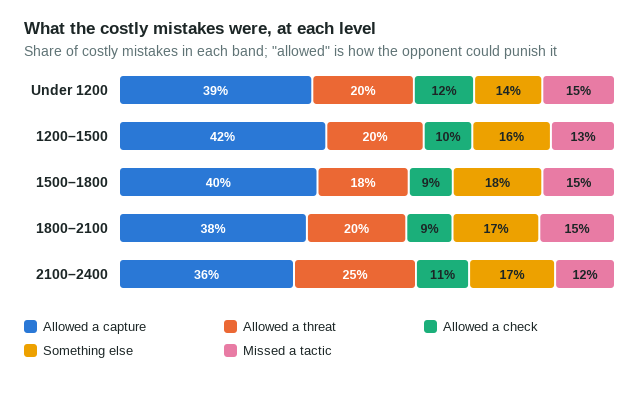
At every level:
- Allowing a capture is the biggest single kind of mistake, between 36% and 42% of costly mistakes in every band: a piece left where it can be taken, or a defender moved away.
- Captures, checks and threats together account for about seven in ten of all costly mistakes, between 67% and 72%, at every level.
- Missed tactics are a small share, between 12% and 15%. That isn't because players find them: they missed between 29% (at 2,100–2,400) and 41% (under 1,200) of the winning tactics that came up. It's because winning tactics come up so rarely.
- About a fifth of costly mistakes come in endgames, between 17% and 21% in every band up to 2,100. The exception is 2,100–2,400, at 29%: more on that below.
With 400 games in each band, each of these shares is good to about three or four points either way, and almost every difference between bands is smaller than that. The steady picture, the same mix at every level, is the finding.
How big the mistakes are
Not every slip loses the game on the spot. Of all the moves that gave away a pawn or more in a balanced position, the share that cost between one and two pawns rises with rating, from 44% under 1,200 to 58% at 2,100–2,400. The outright disasters, five pawns or more or allowing mate, fall the other way: 14% of them under 1,200, about one in seven, and 7% at 2,100–2,400. Stronger players' mistakes are smaller as well as rarer.
Where to train at each level
Because the mix is so similar, the main advice is the same for everyone: check every move for the captures, checks and threats it allows. That one habit covers seven in ten of the costly mistakes at every level, as we saw in Check your move before you play it, and it's what the blunder trainer drills.
With 400 games in each band, one difference between levels stands out clearly:
- 2,100 to 2,400: 29% of costly mistakes come in endgames, against 17% to 21% below 2,100, and the intervals don't overlap. Threats are a little higher here too, at 25%. Mistakes are rare at this level, about one every sixteen moves, and when they come, the endgame is where. Endgames questions, judging won, drawn or lost before playing, are worth more here than anywhere.
Below 2,100 the bands are alike to within a few points. Our first look, with about 100 games a band, seemed to show leanings (more threats under 1,200, more missed tactics at 1,200–1,500), but with four times the games they disappeared. Your rating band says little about which mistakes you make; your own games say much more.
Whatever your rating, most of the points you lose go on moves that a few seconds of checking would have caught.
How OptiChess uses this
OptiChess keeps a separate rating for each skill and serves more of the kinds of question you're weakest at, so your training leans towards your own mistakes rather than the average player's. Your chess has a shape explains how the profile is built.
How we checked
- Games: 2,000 Lichess games, 400 in each of five rating bands. Both players' ratings are inside the band, and each game in a band comes from a different player. 490 come from our library of real Lichess games; the rest were fetched from Lichess, games between other players in the same bands.
- How precise: we resampled the games 2,000 times. The intervals quoted are 95% intervals: moves between costly mistakes, for example, is 5.3 (4.8 to 5.8) under 1,200 and 15.8 (14.5 to 17.1) at 2,100–2,400.
- Moves between costly mistakes: a player's moves made while the position was within three pawns either way, divided by their costly mistakes. The opening (the first ten moves) is left out.
- A costly mistake: a move that gives away two pawns or more from a position within three pawns either way, or a winning tactic not played. A winning tactic is a single move that puts the side to move two pawns or more ahead, as defined in the first post.
- What punished it: Stockfish's best reply for the opponent. "A threat to a piece" means a quiet reply after which one of the player's pieces or pawns is attacked and is undefended or worth more than its cheapest attacker; it ignores pins and deeper ideas, so it's a rough count.
- An endgame: each side has at most 13 points of pieces (pawns and king not counted), for example a rook, a bishop and a knight.
- Engine: Stockfish at depth 18, giving its two best moves in every position.
- The stronger players: a separate sample of 300 games, mostly between players rated over 2,300, gave a costly mistake every 19.7 moves, with much the same mix.
Try it. Real positions, set at your level, every answer checked against the board. No account needed to start.
Start training